
How to Source Candidates Without Being a Recruiter: A Hiring Manager's Guide
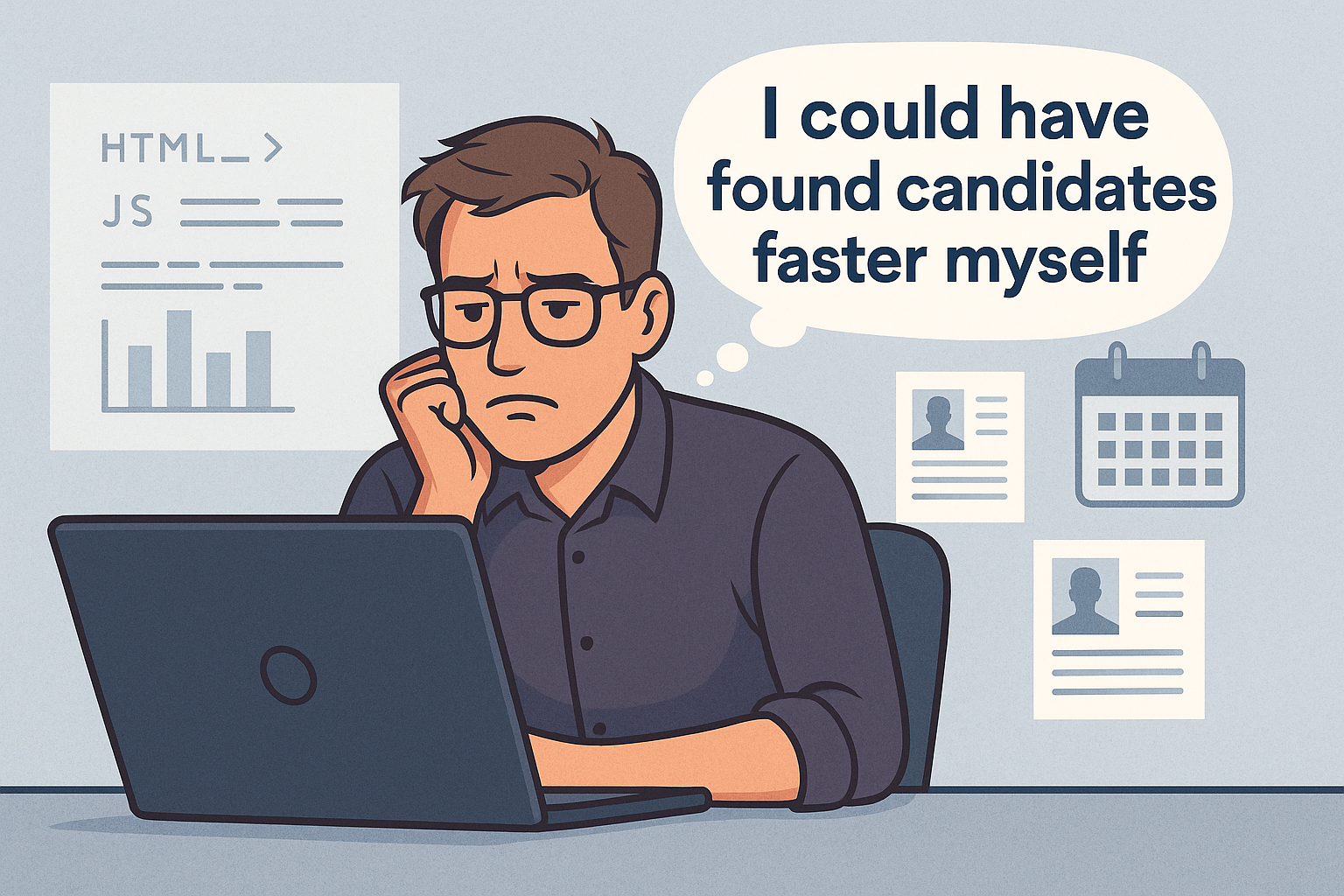
You're a VP of Engineering. Your team is drowning, and you need a senior developer yesterday. You describe exactly what you need to your recruiter—specific tech stack, years of experience, type of problems they should have solved. Then you wait. Two weeks later, you get a batch of candidates, and half of them aren't even close to what you described. You think to yourself: "I could have found these people faster myself." But you don't have access to recruiting tools, you don't know how to write boolean search strings, and LinkedIn Recruiter costs $10,000 a year. So you wait. And wait. And your team keeps burning out.
Here's what most people don't realize: you don't need to be a professional recruiter to find great candidates. In fact, you might be better at it than recruiters are—if you had the right tools. According to a recent LinkedIn survey we conducted, 70% of hiring managers agreed that if it only took 10 minutes, they should create the candidate shortlist themselves instead of waiting for recruiters. The problem isn't that managers lack the ability to source candidates. The problem is that all the sourcing tools are built for professional recruiters, locked behind expensive paywalls, and require expertise that hiring managers don't have time to develop. But that's changing. AI-powered recruiting tools are making candidate sourcing accessible to anyone who knows what they're looking for—and as a hiring manager, you definitely know what you're looking for.
Why Traditional Sourcing Is So Hard (And Why You Can't Just "Do It Yourself")
Let's be honest about what professional recruiters actually do during candidate sourcing. It's not magic—it's a specific set of skills and tools that most hiring managers don't have access to. First, there's LinkedIn Recruiter, the $10,000/year platform that lets you search beyond your network and use advanced filters. Then there's boolean search syntax—those weird strings like "(React OR Angular) AND (Senior OR Lead) AND Austin" that let you find specific candidates. Recruiters also know which job boards to search (GitHub for engineers, Behance for designers, AngelList for startup folks), how to use applicant tracking systems, and how to navigate sourcing databases most people have never heard of.
This isn't a knock on hiring managers—you shouldn't need to know this stuff. You're an expert in your domain, not in recruiting technology. But this expertise gap creates a dependency: you need a recruiter to find candidates because the tools and techniques aren't designed for you. A VP of Sales shouldn't need to learn boolean operators to find an account executive. A Head of Product shouldn't need a $10K software license to find a product designer. The barrier isn't your ability to identify great candidates—it's your access to the tools that find them.
The result is frustrating for everyone. Hiring managers wait 10-14 days for the first batch of candidates while their teams suffer. Recruiters spend 40% of their time on grunt-work sourcing instead of building relationships with candidates. And even when candidates finally arrive, there's often misalignment because recruiters don't have the deep domain expertise that managers have. You know what "scaling microservices in a high-traffic environment" actually means in ways that a recruiter might not. You can spot a great product manager's portfolio in 30 seconds because you've been doing the job for years. The problem isn't knowledge—it's that the sourcing tools aren't accessible to people with your knowledge.
The Hiring Manager's Secret Advantage: You Actually Know What You're Looking For
Here's something recruiters won't tell you: hiring managers are often better at identifying the right candidates than recruiters are. Why? Because you've done the job. You know what "senior React developer" actually means—not just the keywords, but the type of problems they should have solved, the architecture decisions they should understand, the trade-offs they should be comfortable making. When you look at a candidate's GitHub profile, you can tell in seconds whether their code is good. When you read a product manager's case study, you immediately know if they think strategically or just push pixels.
Recruiters are great at many things—building relationships, selling opportunities, managing interview processes, negotiating offers. But they're generalists by necessity. A recruiter might work on five different roles simultaneously across engineering, sales, marketing, operations, and finance. They can't possibly have deep expertise in all those domains. You, on the other hand, have spent your entire career in your field. You know what good looks like. You know which skills matter and which are just resume fluff. You know the difference between someone who's done the job at a startup versus someone who's done it at a large enterprise. This domain expertise is incredibly valuable—and it's wasted when you're stuck waiting for someone else to figure out what you already know.
According to our LinkedIn survey, 70% of hiring managers agreed with this statement: "If it only took 10 minutes, should hiring managers create the shortlist instead of recruiters?" That's a remarkable number. It tells you that most managers don't want to replace recruiters—they just want to stop waiting for the part they could do themselves. They want to leverage their domain expertise to kickstart the process, then hand off to recruiters for the relationship-building and closing work that recruiters are actually good at. The question isn't whether hiring managers should source candidates. The question is: why are we making them wait weeks for something they could do in minutes if they had the right tools?
How AI-Powered Sourcing Makes This Possible (Without Becoming a Recruiter)
The game-changer is conversational AI that eliminates the expertise barrier. Instead of learning boolean search syntax or mastering LinkedIn Recruiter's 47 filters, you just describe what you need in plain English: "I need a senior React developer in Austin with experience scaling applications to millions of users." The AI asks you clarifying questions the same way a recruiter would: "Are you looking for someone currently in this role, or anyone with this experience in their background?" "What company size experience matters—startup, growth-stage, or enterprise?" "Do they need to be local or are you open to remote?" You answer in your own words, and the AI translates your requirements into actual search queries across massive databases.
This is exactly how Jobz works. Our AI-powered chatbot searches 800 million professional profiles sourced from across the web—LinkedIn, GitHub, company websites, and other public sources. You don't need to learn recruiting tools or pay for expensive licenses. You just tell the AI what you're looking for, and it handles the technical complexity of searching, filtering, and ranking candidates. Within about five minutes, you have a ranked shortlist of candidates with AI-powered match scores. You can review profiles, like the ones that look promising, and export the list—either to hand off to your recruiter or to reach out to candidates directly if you don't have recruiting support.
The beauty of this approach is that it plays to your strengths. The AI handles the grunt work of searching databases and applying filters. You handle the part you're actually good at: recognizing great candidates when you see them. When you review a candidate's profile and experience, you're not guessing whether they're qualified—you know because you've done the job yourself. You can spot the signal in seconds. The AI just makes sure you're looking at the right 15 people instead of wasting time scrolling through thousands of profiles. It's the perfect division of labor: AI does the scale work, you do the expertise work.
A Step-by-Step Guide to Sourcing Candidates as a Non-Recruiter
Let's walk through what this actually looks like in practice. Imagine you need to hire a senior full-stack engineer for your startup. Here's how you'd approach it using AI-powered sourcing instead of waiting for a recruiter:
**Step 1: Define what you need (2 minutes).** Open your AI sourcing tool and describe the role in your own words: "I need a senior full-stack engineer with React and Node.js experience who's worked at a fast-growing startup." The AI will ask follow-up questions: "What location?" "Current role or anyone with this experience?" "Years of experience?" "Company size preference?" Answer these questions the same way you'd answer them if a recruiter asked. No jargon needed—just describe what matters to you.
**Step 2: Let AI search and rank (3 minutes).** The AI searches hundreds of millions of profiles, applies your criteria, and ranks candidates by relevance. You're not doing anything during this step—the AI handles it. Behind the scenes, it's doing the work that would take a recruiter hours: searching multiple databases, applying filters, scoring candidates against your requirements, and organizing results.
**Step 3: Review the shortlist (5 minutes).** You get a list of 15-20 candidates ranked by AI match scores. Now you do what you're actually good at: quickly scanning profiles to spot the right people. As an engineering leader, you can tell in 30 seconds whether someone's experience is relevant. You can see if they've worked on problems similar to yours. You can check their GitHub to see if they write clean code. You're not guessing—you're leveraging your domain expertise to identify the best matches.
**Step 4: Export and hand off (1 minute).** You've identified 8 candidates who look great. Export the list to a CSV or send it directly to your recruiter with a note: "These 8 look like strong matches—can you reach out and start conversations?" Your recruiter now has a head start. Instead of spending 10 hours building a list from scratch, they can immediately focus on what they're good at: engaging candidates, selling the opportunity, and moving people through your interview process. Total time invested by you: 10 minutes. Time saved by your recruiter: 10 hours. Time saved by your team: 2 weeks of waiting.
The entire process takes less time than your morning standup meeting. You're not becoming a recruiter—you're just using your domain expertise to kickstart the process instead of waiting for someone else to figure out what you already know. And because you built the list yourself, you're confident these candidates actually match what you're looking for. No more "this isn't what I asked for" conversations after two weeks of waiting.
The New Model: Hiring Managers Source, Recruiters Close
This isn't about replacing recruiters—it's about everyone doing what they're best at. The traditional model where recruiters do everything (sourcing + engagement + closing) made sense when sourcing required specialized tools and expertise. But AI has democratized sourcing. Now the question is: why should hiring managers wait weeks for recruiters to do something they could do themselves in 10 minutes?
The new model is partnership through division of labor. Hiring managers leverage their domain expertise to build an initial candidate shortlist using AI-powered tools. This takes 10 minutes and eliminates the waiting period where teams suffer. They hand that shortlist to recruiters, who focus on what they're actually good at: building relationships with candidates, selling the opportunity, managing the interview process, negotiating offers, and closing deals. Recruiters get their time back from grunt-work sourcing and can focus on the high-value activities that actually require human expertise. Everyone does what they're best at, and hiring happens in days instead of months.
We've seen this model work incredibly well in practice. Hiring managers tell us they feel empowered instead of helpless—they can take immediate action when they realize they need to hire instead of waiting for the process to start. Recruiters tell us they love getting pre-built shortlists because it means instant alignment on candidate profiles and more time for relationship-building. Companies see faster time-to-hire, better collaboration between managers and recruiters, and higher quality candidates because the people with domain expertise are involved from day one. The 70% of managers who said they should create the shortlist if it only took 10 minutes? They're right. And now they can.
You don't need to become a recruiter to find great candidates. You just need tools that work the way you think instead of requiring you to think like a recruiter. You have the domain expertise. You know what you're looking for. Now you can finally act on that knowledge instead of waiting for someone else to translate it into search queries and database filters. Stop waiting. Start sourcing.